
31 Tips for Visiting the Colosseum in Rome in 2026 (+ Tourist Mistakes)
Planning a trip to Rome is one of those “pinch-me” moments, but nothing ruins the magic faster than standing in the shadow of the world’s most iconic amphitheater only to realize you can’t actually go inside.
It happens more often than you’d think. Travelers arrive excited, only to find that tickets are sold out weeks in advance, and they should not have listened to that friend who told them to buy them on the spot. The heartbreak of missing out on the Colosseum during your limited time in the Eternal City is a pain point I want to help you avoid entirely.
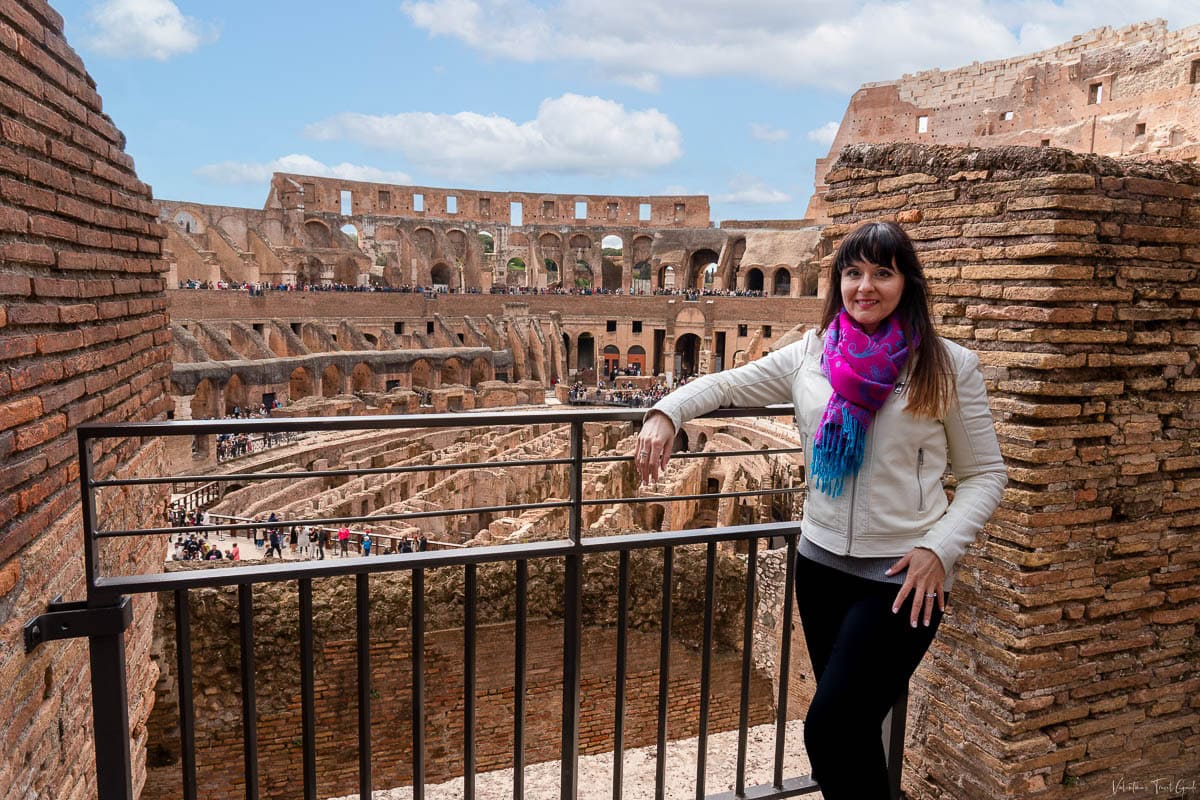
I’ve walked through those ancient arches more times than most, four times, to be exact! Because I always seem to be the designated “tour guide” for different travel mates, I’ve seen the Colosseum in every light and every season.
From the frantic midday rush to the quiet, golden hues of a late afternoon, I’ve learned exactly what works and, more importantly, what doesn’t.
Whether you’re a first-timer or a returning history enthusiast, my goal is to ensure your visit is seamless, stress-free, and truly awe-inspiring. This guide is designed for the traveler who wants to skip the chaos and dive straight into the wonder.
These are my tried-and-tested tips for visiting the Colosseum in Rome to ensure you don’t just see the monument, but truly experience it.

Hi! I’m Valentina
I help travelers avoid travel anxiety by providing all the necessary info and tips to plan the most organized trip. Be part of my super-anxious travelers to receive my 42-page guide to becoming a super-organized traveler, weekly travel discounts, detailed itineraries, and more. Let’s fight travel anxiety together!

MORE ROME TRAVEL GUIDE TO HELP YOU PLAN YOUR TRIP
- PLAN YOUR TRIP: Tips & info on how to plan your trip to Rome and avoid travel anxiety, best months to visit Rome, the best tips to visit Rome as a local, the huge mistakes to avoid in Rome to avoid any kind of mishap, and how to go from the airport to your hotel.
- WHERE TO STAY: From the most romantic honeymoon hotels in Rome, the top boutique hotels in Trastevere, to the incredible hotels in the city center with a rooftop terrace, there is a place for all your needs.
- WHAT TO EAT: From a guide to the local Roman dishes to taste, to the most delicious Roman pastries and desserts.
- WHERE TO EAT: From the best breakfast spots in Rome to unmissable street food lunch spots, the most authentic gelaterias loved by locals, and tiramisu places, as well as local restaurants in Rome and breathtaking rooftop bars & restaurants.
- WHAT TO DO: Explore the best places in Rome and visit the top Roman museums. Learn how to visit the famous Colosseum before booking one of the 14 best tours of the Colosseum and Forum and one of the top 12 early access Vatican Museums tours for the best experience. If you love cooking, then attend a pasta and tiramisu class, or one of the top pizza-making classes with wine. If you just wish to eat, then one of the Roman food tours is what you need.
- ITINERARIES: Explore Rome with my 3-day itinerary and the complete 4-day itinerary, with local food stops already planned.
Tips for Visiting the Colosseum in Rome
Planning Your Visit: Booking and Tickets

1. Don’t arrive in Rome without a timed-entry ticket:
I have visited the Colosseum four times, and I always advise anyone visiting Rome that knowing how to buy Colosseum tickets should be their top priority. I once had a couple reach out to me in a total panic while they were already standing in the heat of Rome.
They texted me via my Facebook Page to ask where they could find a last-minute entry, only to realize too late that everything was sold out for their entire stay.
It was difficult to tell them that “winging it” just doesn’t work for such a popular city. I always purchase my ticket well in advance because I refuse to let that kind of uncertainty ruin my vacation. Most days, tickets sell out weeks in advance, especially during the busy months from April to October.
To help, I sent them a link to view all Colosseum tickets available for that week across reputable reseller platforms I use. Even if you visit in winter, you should never risk arriving without a reservation.
The ticket office often closes for the day once the pre-booked slots are filled, and you might spend your precious Roman holiday staring at the walls from the outside. This is one of my top tips for visiting Rome: book your attractions in advance.

2. Book your tickets as soon as you have your travel dates:
When you are planning on visiting the Colosseum in Rome, the timing of your booking is everything. You should never wait until the last minute, as Official Colosseum tickets are released in strict 30-day and 7-day windows. I always recommend booking a tour with a 24-hour free cancellation policy as soon as you know your dates to avoid the stress of missing out.
I remember when I was planning a trip to Rome with my best friend Pamela, and we were both so nervous about the tickets selling out. By booking a tour with a flexible cancellation policy through my preferred providers, we secured our spot months in advance. This gave us total peace of mind knowing we could get a full refund if our plans changed.
Tour operators often have access to tickets before the general public’s windows open on the official site. If you decide to go on your own, you will need to be patient and check the official website regularly for new ticket batches 30 days in advance. To make your life easier, I have written a guide to the best Colosseum tours with flexible cancellation so you can plan your trip without the typical travel anxiety.
PIN IT FOR LATER


No time to read it now?
Save it for later.
3. Follow the “Nominal Ticket” rule to avoid being turned away:
One of the most important Roman Colosseum rules you need to know is that all tickets are now nominative. This means your full name must be printed on the ticket and exactly match your physical ID. I have seen security guards turn people away just because they used a nickname or made a slight typo during the booking process, which is a nightmare for any traveler.
When I visited Rome with my parents (every excuse is good to visit Rome again and again), I was extra careful to double-check every letter of their names while booking. I knew that if the names didn’t match their passports, we wouldn’t even get past the first checkpoint. It might seem like a lot of bureaucracy, but it is a necessary measure to prevent ticket resellers from charging unfair prices.
Make sure you have your original passport or a valid government-issued photo ID with you upon arrival. I have heard some visitors just used a photo of their ID on their phone, while others told me no one checked their IDs at the gate.
I would never risk it myself; my anxiety would ruin my day. My lovely, anxious traveler, please take a few extra minutes to verify your details so you can walk through those gates with complete confidence and pack your ID, just in case. This is one mistake tourists should avoid in Rome.

4. Decide which Colosseum tickets to buy before they sell out:
Choosing which Colosseum tickets to buy can be confusing because not all tickets offer the same level of access. I have explored the monument in different ways, and I always tell my friends to decide on their must-see area before they even look at the booking site.
If you only buy a standard ticket, you will be able to visit the first and second tiers, but you will be barred from stepping onto the Arena Floor or descending into the Underground.
When I visited with a small group of friends a few years ago, we knew we wanted the most immersive experience possible, so we booked a tour of the Underground. Please note that these underground guided tours also include Arena access as part of the package.
It was fascinating to see the backstage area where the gladiators and animals once waited before stepping onto the stage where the action took place.
Keep in mind that these special access tickets are much harder to get and often sell out in seconds. If you find the official site too stressful, remember that many Colosseum & Roman Forum guided tours include these restricted areas to save you the headache of hunting them down. My best advice for my lovely, anxious traveler is to prioritize what matters most to you so you do not end up disappointed at the gate.

5. Weighing the official site against reseller flexibility:
One of the biggest choices you will face is whether to use the official Colosseum ticket website or a trusted reseller platform. If you purchase directly from the official concession, your tickets will be non-refundable, which can be a massive source of stress for any traveler. I have seen plans fall apart at the last minute, and losing money due to a flight delay or a sudden change of heart is the last thing you want.
When planning a trip, I often prefer a reliable reseller because they typically offer a 24-hour cancellation policy. Even though these tickets might be a few Euros more expensive, that small extra cost buys you a massive amount of peace of mind. If you cannot make it to the monument for any reason, you can receive a full refund if you cancel at least 1 day in advance.
The official site releases tickets in batches and can be very competitive to navigate during peak season. If the official slots are sold out, don’t panic; tour operators often have their own ticket inventory. My lovely, anxious traveler, choose the option that makes you feel most secure so you can focus on the history rather than the “what-ifs.”

6. Choose the right tour to match your group and budget:
Deciding on the best way to tour the Colosseum really depends on who you are traveling with and how much you want to dive into the history. I have visited the Colosseum four times, and I can tell you that having a local guide to answer your questions and share hidden stories makes the experience so much richer.
When I booked a private tour just for a group of friends and me, it was perfect because we could go at our own pace and focus on the things that interested us most.
If you are visiting with your family or a small group of friends, a private tour is the ultimate stress-free way to explore ancient Rome. You won’t have to worry about losing your group in the crowds or feel anxious about asking too many questions of the tour guide.
It feels like having a knowledgeable friend show you around their city, which is precisely the kind of highly organized experience I love.
If you are traveling as a couple and want to save money while still enjoying a VIP experience, a small-group tour is the perfect middle ground. I did this twice, and it was fantastic because the groups were tiny enough that we could still ask plenty of questions and move through the site efficiently.
It eliminates the chaos of large 50-person groups, which I found very difficult to follow during my only large-group tour.
Choose Your Perfect Colosseum Tour
Need to book fast? Here is the ultimate shortcut! Based on your priorities, select the single Best Tours of Colosseum and Forum option that eliminates stress and maximizes value.
- Best Private Tour: Private Colosseum, Roman Forum, and Palatine Hill Tour.
- Best Private Early-Access: First Entry Private Colosseum & Roman Forum Tour with Special Arena Access.
- Best Small Group Tour: Colosseum Underground and Roman Forum.
- Best Luxury/Atmosphere: Last Entry Colosseum, Arena Access & Rooftop Aperitif.
- Best Night Tour: Colosseum Night Tour with Underground Access.
- Best Large Group Tour: Ancient Rome Guided Tour: Colosseum, Forum, and Palatine.
- Best Audio Guide Tour: Colosseum, Arena & Roman Forum + Audio Guide.
7. Use the MyColosseum app as a digital booking hack:
A great modern trick for your visit when purchasing your ticket on the official website is downloading the official “MyColosseum” app. This tool helps you keep your digital tickets organized in one place, which is a massive relief for any traveler who worries about losing paper printouts or scrolling through hundreds of emails at the security gate.
The app provides interactive maps and official audio content that can help you navigate the massive archaeological park. Since the Roman Forum and Palatine Hill are quite sprawling, having a map on your phone can save you from wandering in circles when you are already tired from walking.
One thing I have noticed during my four visits is that the signal around the ancient stone walls is often weak. I highly recommend downloading the app and all necessary content while you are still at your hotel. This way, you have everything ready to go offline, ensuring a much smoother entry process without any technical glitches at the gate.
When to Go: Timing and Crowds

8. Strategize your schedule to beat the crowds:
Based on my four visits, I have learned that your timing can change everything. When people ask me “what is the best time to visit the Colosseum?”, I always recommend early access. Booking a first entry tour at 8:30 AM is ideal, as it gives you the entire morning to explore the Colosseum, the Roman Forum, and the Palatine Hill before the midday heat and large tour groups arrive.
I have explored the monument twice in the morning and twice after lunch, and both have their perks depending on the season. In winter, lunchtime or after-lunch slots are ideal for avoiding the morning chill; during my winter trip with my parents, this made outdoor walking much more comfortable.
In the summer, however, stick to the very early morning, late afternoon, or evening hours to avoid the sweltering heat. My lovely, anxious traveler, picking these “off-peak” hours is the secret to getting those perfect photos without the heavy crowds.
Make sure to plan your visit to the Colosseum effectively; it is one of the unmissable places to see in Rome.
9. Don’t visit it at midday in the summer heat:
If you are planning your holiday in Rome in July or August, prepare for very hot weather. Rome can be stifling during these months; in fact, the city’s official record high temperature was 41.8°C (107.2°F) in July 2023. Standing inside a stone amphitheater with thousands of other people in that kind of heat is a recipe for exhaustion rather than a dream trip.
I have heard of many travelers trying to push through a mid-day visit in the peak of summer, only to end up needing to sit down in the shade after just twenty minutes. There is minimal shade inside the monument, and the white stone reflects the sun, making it feel hotter than the thermometer indicates.
My advice for my anxious traveler is to avoid the 12:00 PM to 3:00 PM window entirely during the summer to ensure you actually enjoy the history rather than just counting the minutes until you can find some air conditioning.
Visit it in the morning after enjoying some local Roman pastries at some of the best cafes in Rome, or in the early afternoon, after having some local delicacies at one of the most local street food places in Rome, or maybe attending one of the local lunch food tours nearby.
Colosseum Opening Times: Summer vs. Winter
I’m sure you are wondering, ‘What time does the Colosseum open and close?’ So here you have it: The Colosseum’s closing time varies throughout the year based on daylight hours.
While it almost always opens at 8:30 AM, the gates close much earlier in the colder months. Here is a quick breakdown of the official schedule for the 2026 Colosseum opening hours:
| Winter (Jan 1 – Feb 28) | 8:30 AM | 4:30 PM (3:30 PM) |
| Early Spring (March 1 – March 28) | 8:30 AM | 5:30 PM (4:30 PM) |
| Peak Summer (March 29 – Sept 30) | 8:30 AM | 7:15 PM (6:15 PM) |
| Autumn (Oct 1 – Oct 24) | 8:30 AM | 6:30 PM (5:30 PM) |
| Late Winter (Oct 25 – Dec 31) | 8:30 AM | 4:30 PM (3:30 PM) |
- The Roman Forum & Palatine Hill: While the Colosseum opens at 8:30 AM, the Roman Forum and Palatine area usually open slightly later at 9:00 AM.
- Holiday Closures: The park is closed on 25 December 2025. However, it will be OPEN on 1 January 2026.
- Free Admission Days: You can visit for free on the first Sunday of the month, as well as 25 April (Liberation Day), 2 June (Republic Day), and 4 November (National Unity Day).
Travel Safety Tip: As soon as you book your next adventure, buy good travel insurance in case you need to “unfortunately” delay, extend, or cancel your trip. I usually find good deals on VISITORSCOVERAGE for up to 1 month of trip length and SAFETYWING for longer trips. They are insurance companies that cover everything related to your travel.

10. Avoid visiting on Free Sundays (and why I skip them):
Even though the “Free Sundays” (the first Sunday of every month) and other free dates, such as April 25th and June 2nd, now use time slots to manage crowds, they are still days I personally avoid. While the time slots prevent the monument from reaching unsafe levels, the sheer volume of people entering simultaneously can still feel overwhelming for anyone who prefers a quieter visit.
Because these tickets are free, you generally cannot pre-book them online in the same way as regular tickets; instead, you often have to pick them up in person on the day. This means that to secure one of those timed entries, you still have to get to the ticket office extremely early.
Lines for these free tickets form long before the gates open at 8:30 AM, and if you arrive too late in the morning, the day’s slots may already be gone.
My advice is that your time is often more valuable than the cost of a standard ticket. By paying for a regular reserved entry on a different day, you avoid the massive queues on the “free day” and have a much more predictable, relaxed experience. If you choose a free day, please be prepared for a very early start and a bit more hustle than usual.
THE SECRET TO LOOKING POLISHED ANYWHERE
Eliminate the stress of packing and guarantee you arrive fully prepared to feel fabulous.

11. Weekdays vs. Weekends: Finding a stress-free window:
If you are looking for the most relaxed atmosphere, choosing the right day of the week is just as important as the time of day. Generally, Tuesdays and Wednesdays are the best days for a stress-free visit in winter. Most weekend travelers have headed home by then, and the midweek lull makes the surrounding streets and security lines often much more manageable.
I have found that weekends, especially Saturdays (but only in winter, as in Spring and Summer all tickets are sold out every day), are the busiest times to be near the monument. Not only do you have international tourists, but many people from other parts of Italy visit Rome for a weekend getaway.
If your schedule allows, I highly recommend scheduling your visit for Tuesday morning, which is the best day to visit the Colosseum. Booking a midweek slot is a simple way to reduce the intensity of the experience. If you must visit on a weekend, stick to that 8:30 AM “early bird” rule we discussed earlier to stay one step ahead of the Saturday rush.
12. Experience “Luna sul Colosseo,” the magic of a night tour:
If you want to see the monument in a completely different light, I highly recommend the “Luna sul Colosseo” night tours. These evening openings allow you to walk through the amphitheater after the general public has left, creating a quiet and mysterious mood that you can’t get during the busy daylight hours.
During these tours, you are part of a small group, making the experience feel much more exclusive and intimate. It is a fantastic option for my anxious traveler because the chaotic noise of daytime crowds is replaced by peaceful silence.
These tours are seasonal and sell out quickly, so book well in advance. It’s also the perfect way to avoid the summer heat!

13. Mark your calendar for closures and “Good Friday” warnings:
If you are planning your trip around major holidays, please note that the Colosseum is closed or has limited access on specific dates. While the monument is open almost every day of the year, it is strictly closed on December 25th. Interestingly, while many people assume it’s closed on New Year’s Day, it is actually open on January 1st, 2026, which is a great way to start the year!
The biggest “trap” to watch out for is Good Friday (April 3, 2026). Every year, the Pope leads the Via Crucis (Way of the Cross) procession at the Colosseum in the evening. As a result, the entire archaeological area, including the Colosseum, Roman Forum, and Palatine Hill, usually closes around lunchtime (typically at 1:00 PM, with the last entry at noon).
If you have a ticket for a later slot that day, it will likely be cancelled, so I always advise avoiding Good Friday altogether for a standard visit.
For my lovely, anxious traveler, knowing these “hidden” early closures is essential for a stress-free trip. If you are in Rome on Good Friday, consider visiting on Thursday or Saturday instead to ensure you have enough time to see everything without being rushed out by security teams preparing for the Papal ceremony.

14. Prefer comfort over fashion for ancient stones:
When preparing for your Roman adventure, my best advice is to prioritize comfort over fashion. While Rome is a fashion capital, the ancient stones of the Colosseum and Roman Forum are no place for heels or flimsy sandals. I always wear comfortable shoes when exploring a city, as the terrain is uneven, dusty, and involves steep, ancient stairs.
If you are wondering what to wear to the Colosseum in Rome, keep it practical. While there is no strict religious dress code like at the Vatican, I always carry a lightweight scarf to cover my shoulders if I later pop into a basilica.
Keep your bag small as well; large backpacks are prohibited and must pass through security. Pack only the essentials: your physical ID, a power bank, and a reusable water bottle.
WANT TO KNOW ALL ABOUT FOOD IN ROME?
What to eat in Rome can be a delicious, yet daunting, question, right? Don’t just settle for the tourist traps; start your day in one of the most local Roman breakfast spots. Find the best street food lunch in Rome and the absolute best Roman restaurants where the locals actually eat.
And, oh, the desserts! We’re talking beyond the classics, yes, you need to try the famous pastries & desserts in Rome, but let’s also find the most delicious Roman gelato spots, and hunt down that legendary pistacchio tiramisu in Rome I keep raving about!
If you fancy learning to cook like an Italian, book a pasta and tiramisu class or a fantastic pizza class with wine for couples, or attend an authentic Roman food tour.
And for those special evenings, check out my curated list of romantic restaurants in Rome with a view, because trust me, some memories are best made with a side of panorama. Let’s make your Roman food adventure legendary!

15. The “No Bags” rule: What you can and cannot bring inside:
Security at the Colosseum is very similar to that at an airport. Every visitor must pass through a metal detector and an X-ray machine, which brings me to a significant warning: there are no luggage storage facilities inside the Colosseum.
You may bring a small to medium-sized backpack or a standard handbag (the general rule is nothing larger than 40 x 35 x 15 cm). If your bag is too large, security will deny you entry. If you are traveling with large luggage, you will be asked to leave it somewhere outside.
My advice is to leave your big suitcases at your hotel or use one of the private luggage storage shops around the area.
Aside from the size rule, here is a quick list of what you cannot bring inside:
- Sharp objects: This includes pocket knives or large pointed umbrellas.
- Glass bottles/containers: Only plastic or metal is allowed.
- Alcoholic drinks: These will be confiscated.
- Aerosols: Leave your spray deodorants or perfumes at the hotel.
Love the organized traveler’s life?
Tired of travel anxiety ruining your getaways?
✈️ Join my community of anxious travelers and unlock stress-free adventures. 🔓 You’ll receive:
- Weekly travel tips & discounts
- Detailed itineraries and a budget planner
- My FREE 42-page guide to becoming a super-organized traveler
And much more! Start planning your dream vacations with confidence.


16. Hydration hack: The “Nasoni” and the magic sparkling water:
Staying hydrated is essential in Rome, especially when you’re walking miles in the sun. You’ll notice small, cast-iron fountains called nasoni (meaning “big noses”) scattered all over the city. These provide free, ice-cold, and perfectly safe drinking water that flows constantly from the mountains.
But here is a pro secret: there is also a high-tech “Water House” (Casa dell’Acqua) right outside the Colosseum that provides free sparkling water! All you need is your own reusable bottle to fill up. Lajos and I never travel without our heavy-duty reusable bottles. They are amazing because they keep hot liquids hot for up to 24 hours and cold drinks cold for up to 48 hours.
For my lovely, anxious traveler, remember that you can bring these bottles through security as long as they aren’t glass. Carrying your own bottle doesn’t just save you money; it helps reduce the tons of plastic waste generated by tourism every year.

17. Protecting yourself from the Roman sun, summer essentials:
If you’re visiting the Colosseum in the warmer months or anywhere else in Italy, being prepared for the heat is vital. The sun in the arena is relentless, and there is very little shade while you are exploring the ruins. To stay safe, I always pack a high-quality aloe vera sunscreen.
Aloe vera is a “miracle” ingredient because it hydrates your skin while the SPF blocks the rays, preventing that tight, dried-out feeling you often get after a day of sightseeing.
Along with sunscreen, a good hat and sunglasses are essential for your face and eyes. But the care doesn’t stop when you leave the monument. For my lovely, anxious traveler, I highly recommend keeping a bottle of aloe vera aftersun lotion in the fantastic hotel in Rome you booked.
Applying it after a cool shower is the best way to care for your skin and replenish moisture after many hours in the sun. It’s the ultimate “reset” button so you can feel refreshed for another day of exploring!
18. Screenshot your tickets before arriving:
One of the most practical tips on visiting the Colosseum is to avoid relying on a live internet connection at the entrance. The area around the monument is a “dead zone” for mobile data because the massive stone walls of the Colosseum and the high volume of people using their phones at once create severe signal interference.
I have seen many stressed travelers frantically waving their phones in the air, trying to load an email or PDF as the security line moves past them. To avoid this, take a screenshot of your ticket’s QR code or save it to your Apple/Google Wallet as soon as you receive it.
Having that “digital safety net” ready to go ensures you can scan through the gates in seconds. This is one of those small steps that makes a huge difference in keeping your stress levels low!
Pssst! If you like my content, remember that I covered many destinations worldwide and add more content weekly. So, let’s keep in touch. Subscribe to my free VIP TRAVEL ZEN CENTRAL to become a super-organized traveler, learn how to avoid travel anxiety, and receive weekly updates about new destinations and travel tips.

19. How to reach the Colosseum: Stress-free Metro and Bus tips:
Getting to the monument is actually very simple, but doing it “stress-free” requires a little bit of local knowledge. The easiest and fastest option is to use Metro Line B (the blue line). You’ll want to get off at the “Colosseo” station.
The moment you step out of the station and head up the stairs, the massive amphitheater is right in front of you. It’s a truly breathtaking way to arrive!
A very exciting update for your 2026 trip is the newly opened extension of Metro Line C. As of late December 2025, the new “Colosseo-Fori Imperiali” station is finally open, creating a major interchange.
This means you can now reach the area directly from the eastern parts of the city without multiple bus transfers. The station itself is like a small museum, with artifacts discovered during the excavation on display, so take a moment to look around!
If you prefer the bus, lines 75, 85, and 87 are great options that drop you very close to the entrance. For my lovely, anxious traveler, my best tip is to use the Tap & Go system. You don’t need to hunt for a ticket machine; you can tap your contactless credit card or phone directly on the yellow readers on buses and metro turnstiles.
It’s one less thing to worry about, so you can focus on that first, incredible view of history!
Italy Travel Tip: Most phone providers charge extra fees to use your data plan abroad. If you don’t want to pay a fortune to use the internet in Italy, buying an eSIM for Italy on Airalo is my favorite solution. It’s the fastest and easiest way to have all the data you need while traveling.

20. Don’t think you can park a car nearby:
If you plan to drive in Rome, let me stop you right there: finding parking near the Colosseum is a genuine nightmare. The monument is located in a ZTL (Zona a Traffico Limitato), meaning only residents and authorized vehicles may enter the area during the day.
If you accidentally drive past one of the many enforcement cameras, you will receive a hefty fine in the mail months after your trip ends! Even if you find a private garage outside the restricted zone, it is costly, typically €30-€60 per day.
Street parking is hard to find, and the narrow, busy roads are not conducive to drivers unfamiliar with Roman traffic. My best advice is to leave the car at the fantastic hotel in Rome where you are staying or at a nearby metro station, such as Laurentina, and take the train in. It is much cheaper, faster, and saves you the stress of navigating the city center’s chaos.
YOUR WORRY-FREE COUNTDOWN STARTS NOW
Get the checklist that guarantees you leave home safe and arrive at your destination relaxed.

21. Navigating the three entrances: Which one is yours?
One of the most common questions I get from travelers about the Colosseum is “How many entrances does the Colosseum have?” While the ancient Romans used 80 different numbered arches to enter, today there are only three main entrances for visitors.
Knowing which gate to use is the key to a smooth start, as going to the wrong gate can mean extra walking and stress.
- Sperone Valadier (Main Entrance): This is the entrance for individual ticket holders. If you have a standard timed ticket, a “Full Experience” ticket without a guide, or a Roma Pass, this is where you go. It is located right in front of the Arch of Constantine.
- Group Gate: As the name suggests, this is strictly for organized tour groups of 14 to 50 people. If you have booked a tour through a company and are meeting your guide nearby, they will lead you through this gate.
- Stern Entrance: This is often the quietest gate and is located on the opposite side of the main entrance. It is specifically reserved for visitors with tickets for the Arena Floor, the Underground, or school groups. If you have the “24h Arena Only” ticket, you will likely enter through this gate.
Valentina’s Tip: I recommend arriving 15–20 minutes before your scheduled time to find your gate. Check your digital ticket carefully; it will usually indicate which entrance to use and where to meet your tour guide. If you’re unsure, don’t be afraid to ask a staff member in a yellow vest; they are there to point you in the right direction so you don’t waste time in the wrong line!

22. Don’t arrive too early (but never late):
When visiting the Colosseum in Rome, the security check is the one thing you cannot skip or speed up. It is very similar to an airport: you will place your belongings in a tray, walk through a metal detector, and have your bags X-rayed. Because of this, lines can form quickly, but there is a specific “sweet spot” for when you should join the queue.
I recommend arriving 15–30 minutes before your scheduled time. If you arrive an hour early, security will often ask you to wait to the side because they prioritize the current time slot to prevent the entrance from becoming dangerously overcrowded.
However, the staff is very strict about late arrivals; if you are more than 15 minutes late for your scheduled time, they may refuse entry, and these tickets are non-refundable.
Hey Traveler!
If you find this article helpful, share it on your social media. Maybe someone you know will, too. Let’s help other travelers! Thank you from your super-organized travel blogger!

23. Accessibility: Visiting with a disability or small children:
If you are visiting with limited mobility or a stroller, you’ll be happy to know that the Colosseum is quite accessible, though it requires some strategy. There is a step-free main entrance with ramps and a modern panoramic elevator connecting the ground floor to the second tier. This means you won’t miss out on those famous views of the arena!
Here are a few specific tips for visiting the Colosseum for families and disabled travelers:
The “Slow Path”: Please note that while the main tiers are accessible, the Underground and some upper Attic levels are unfortunately not wheelchair or stroller-friendly due to very narrow passages and steep ancient stairs.
Strollers vs. Carriers: While there are elevators, the terrain inside, outside, and around the monument is made of uneven ancient cobblestones. I highly recommend using a baby carrier instead of a stroller, as navigating the “sampietrini” stones can be very bumpy.
Free Entry: Disabled visitors (with valid documentation) and one companion are entitled to free entry. You don’t need to book these online; you can pick up these tickets at the dedicated “Special Assistance” desk at the entrance.
Restrooms: Accessible restrooms and diaper-changing stations are located near the main entrance and on the first tier.
Inside the Monument: Making the Most of It

24. Don’t think a standard ticket includes the Arena or Underground:
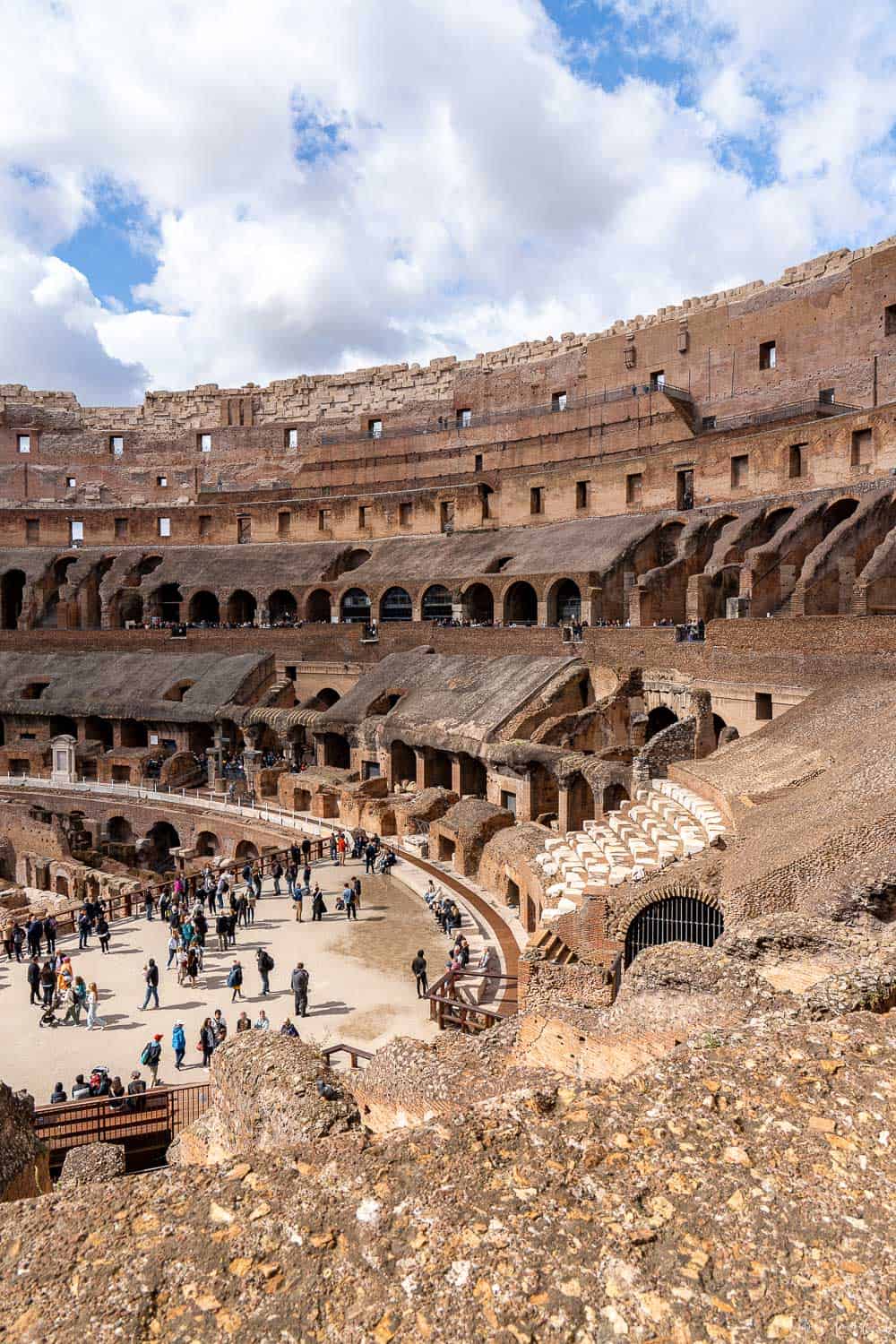
This is perhaps the biggest misconception travelers have. A standard ticket (often called the 24h ticket) only gives you access to the first and second tiers of the Colosseum. From here, you can look down into the center, but you cannot walk on the reconstructed wooden floor where the gladiators fought, nor can you go down into the tunnels below.
If you want to stand “center stage,” you must specifically book a Full Experience Arena ticket. If you want to see the “backstage” where the animals and fighters were kept, you need the Full Experience Underground ticket.
For my lovely, anxious traveler, please double-check your booking! If your heart is set on walking through the gladiator’s gate, a standard ticket will leave you looking at it from the balconies above.

25. Understand the areas: The Arena Floor, the Hypogeum, and the Panoramic Top Tier
The best way to visit the Colosseum in Rome is to decide in advance which level of immersion you want, as each area offers a distinct perspective on history.
- The Arena Floor: This is the partially reconstructed wooden stage where the gladiators actually stood. Walking through the “Gladiator’s Gate” and standing at the center of the monument is an adrenaline-filled experience that makes you feel the stadium’s accurate scale.
- The Hypogeum (Underground): Often called the “backstage” of the Colosseum, this is a maze of tunnels, animal cages, and man-powered elevators. It is incredibly atmospheric and can only be visited with a specialized guide. You can see where the lions were kept before they were winched up to the floor for the show!
- The Panoramic Top Tier (The Attic): For the best views, head to the 3rd, 4th, and 5th levels. This area was recently reopened and requires a “Full Experience Attic” ticket. It includes a ride in a panoramic elevator and offers a 360-degree view of the interior and the city of Rome beyond.
Valentina’s Note: Do you follow my Facebook Page, where I share plenty of travel tips for anxious travelers? Are you part of my Rome Facebook Group, where you can ask me all the questions to help you plan your trip to Rome? Please make sure to do so; see you there!

26. How long does it take to visit all three sites? (Setting expectations):
When you buy a ticket for the Colosseum, it always includes entry to the Roman Forum and the Palatine Hill. One of the biggest mistakes I see travelers make is trying to “squeeze” all three into a two-hour window. To truly see everything without having to run through history, you should budget at least 3 to 4 hours.
Here is how I suggest breaking down your time to keep things stress-free:
- The Colosseum: Plan for about 1 to 1.5 hours. This gives you enough time to clear security, explore the two main tiers, and take plenty of photos.
- The Roman Forum & Palatine Hill: These are located in a separate fenced area right next to the Colosseum. You should set aside at least 2 hours for this part. The Roman Forum is the ancient “downtown” and involves extensive walking on uneven stones, while the Palatine Hill offers beautiful gardens and the ruins of imperial palaces.

27. Watch your step while navigating ancient stairs and slippery surfaces:
While the Colosseum is a marvel of engineering, it is nearly 2,000 years old, so the terrain is far from modern standards. As you explore, you will encounter ancient stairs that are incredibly steep, narrow, and uneven.
Many of the original travertine stones have been worn down by millions of feet over the centuries, making them surprisingly slippery, especially if it has recently rained or if they are covered in fine Roman dust.
Please take your time and use the handrails wherever they are available. I always keep one hand free (so don’t try to take selfies while walking up the steps) to maintain my balance. If you are heading down into the Hypogeum or up to the higher tiers, the lighting can also be a bit dim, making it harder to spot a loose stone or a sudden change in level.
Just remember: there is no rush. Moving slowly not only keeps you safe but also gives you more time to appreciate the incredible textures of the history surrounding you.
Rome Lovers,
Join My New Free ROME Facebook Group!
I just launched a Rome Facebook Group for stress-free Roman adventures.
Come join the fun! It’s the perfect spot to ask all your Rome questions and get local answers to plan your dream trip.
See you there!

28. Avoid pickpockets and handle the “Gladiator” photo trap:
Rome is a safe city, but like any major tourist hub, it has its share of opportunists. Being aware of these two common situations will help you navigate the Piazza del Colosseo with confidence.
How to spot pickpockets: Pickpockets in Rome rarely look like “criminals”; they often blend in as regular commuters or even other tourists. They work in teams and rely on distraction.
- The “Accidental” Bump: If someone bumps into you or spills something on your clothes, your first instinct is to look at the mess. Instead, immediately put your hand on your bag or wallet.
- The Clipboard/Petition: Someone may approach you to sign a “petition for charity.” While you are focused on the paper, an accomplice may be reaching into your pockets.
- The Metro Squeeze: Be extra vigilant at the “Colosseo” Metro station. Pickpockets love the “crush” that happens as people board or exit the train. Always wear your backpack on your front and keep your hand on the zipper.
The “Gladiator” photo trap: You will see men dressed in impressive Roman armor loitering outside the monument. They are very friendly and will offer to take a “free” photo with you or even place a helmet on your head. It is never free. Once the photo is taken, they often become very aggressive, demanding €20, €50, or even more per person.
Valentina’s Tip: If you want a photo, agree on a price before touching any props or posing. However, it is usually better to say “No, grazie” and keep walking. They are technically illegal, so they will usually move on to an easier target if you don’t engage.
YOUR STRESS-FREE FLIGHT STARTS NOW
Get the checklist that guarantees you arrive at your destination looking and feeling your best, stress-free.

Beyond the Arena: The Forum and Palatine Hill

29. Don’t Skip the Roman Forum and Palatine Hill:
Your Colosseum ticket is always a “3-in-1” pass, yet I see so many travelers walk away after the arena, thinking they’ve seen it all. Don’t make that mistake! The Roman Forum and Palatine Hill are included in your entry and are located just a few steps away in a single, vast archaeological park.
- The Palatine Hill: This is where it all began. According to legend, Romulus founded Rome on this very hill. It was the “Beverly Hills” of the ancient world, where emperors built their massive palaces. Today, it features some of Rome’s most beautiful gardens and a stunning bird’s-eye view of the Forum below.
- The Roman Forum: The beating heart of the Roman Empire, the site of elections, public speeches, criminal trials, and gladiator matches before the Colosseum was built. Walking down the Via Sacra (the Sacred Way) feels like stepping back 2,000 years.
Remember that the Forum and Palatine Hill are connected internally, but they are separate from the Colosseum. You have to exit the Colosseum and walk to one of the nearby entrances (I recommend the one on Via di San Gregorio as it’s usually less crowded).
Your ticket allows one entry to the Colosseum and one entry to the combined Forum/Palatine area. Because these sites involve a lot of walking on dusty, ancient paths with very little shade, make sure your reusable water bottle is full!
DID YOU LIKE THIS POST?
Save it on Pinterest!

30. There is a hidden cafe inside the Roman Forum:
After exploring the massive ruins of the imperial palaces, you might find your energy flagging. The Palatine Hill is quite large and involves a fair amount of climbing, but there is a “secret” reward if you know where to look.
Hidden among the lush greenery and ancient brickwork of the Roman Forum, there is a small, charming cafe called La Caffetteria del Parco, where you can take a much-needed seat. It is located near the Palatine Museum (Museo Palatino). While the menu is simple, mainly coffee, cold drinks, and pre-packed snacks, the real draw is the atmosphere.
It’s one of the few places within the archaeological park where you can sit in the shade, surrounded by orange trees and the quiet echoes of history, far away from the heavy crowds of the Colosseum floor.

31. Don’t forget to enjoy an Italian gelato at Il Gelato di Costanza:
What is the point of visiting Rome if you don’t enjoy some great gelato? In fact, I think it should be a mandatory part of your itinerary in Rome! One of my favorite spots to indulge is Il Gelato di Costanza. It’s located just a “stone’s throw” from the monument on Via di San Giovanni in Laterano, making it the perfect treat before or after your climb through history.
This is a wonderful place to take a break because it is artisanal and authentic. Unlike some of the “tourist trap” shops with bright neon-colored mounds of ice cream, Il Gelato di Costanza focuses on high-quality, natural ingredients and is one of the best gelato spots in Rome.
- The View: If you grab a cone, you can walk just a few steps back toward the Colosseum and enjoy your gelato with a stunning view of the ancient stone.
- The Flavors: They offer more than 30 flavors daily, from classics like rich dark chocolate and pistachio to unique creations like yogurt with mango and Macadamia nuts.
- The Vibe: It feels like a little oasis of sweetness in the middle of the busy city center.
Treating yourself to a scoop (or two!) is the ultimate way to reward your legs after all that walking. It’s these small, delicious moments that turn a great trip into an unforgettable one!
Choose Your Perfect Colosseum Tour
Need to book fast? Here is the ultimate shortcut! Based on your priorities, select the single Best Tours of Colosseum and Forum option that eliminates stress and maximizes value.
- Best Private Tour: Private Colosseum, Roman Forum, and Palatine Hill Tour.
- Best Private Early-Access: First Entry Private Colosseum & Roman Forum Tour with Special Arena Access.
- Best Small Group Tour: Colosseum Underground and Roman Forum.
- Best Luxury/Atmosphere: Last Entry Colosseum, Arena Access & Rooftop Aperitif.
- Best Night Tour: Colosseum Night Tour with Underground Access.
- Best Large Group Tour: Ancient Rome Guided Tour: Colosseum, Forum, and Palatine.
- Best Audio Guide Tour: Colosseum, Arena & Roman Forum + Audio Guide.
Is the Colosseum open on Sunday?
Yes, the Colosseum is open on Sundays! It welcomes visitors seven days a week, year-round, except on December 25th and January 1st. Just a heads-up for my lovely, anxious traveler: the first Sunday of every month is actually free for everyone.
While that sounds like a dream for the budget, it usually results in large crowds and long lines. If you want to keep your stress levels low and your experience smooth, I’d recommend choosing another day and booking a timed entry slot in advance!
How long to visit the Colosseum?
Honestly, 1 hour is enough! It’s the perfect amount of time for my lovely, anxious traveler to soak in the epic history, snap those “I’m really here!” photos, and marvel at the architecture without feeling overwhelmed.
Sticking to a 60-minute visit keeps your schedule super-organized and leaves you plenty of energy (and time!) for a relaxing Aperol Spritz at a nearby luxury terrace.
What is the best day of the week to visit the Colosseum?
If you’re visiting during the winter months, midweek is your secret weapon! Weekdays (Tuesday to Thursday) are the absolute best for my lovely, anxious traveler to enjoy a calmer atmosphere and shorter lines.
However, keep in mind that during the warm months, it’s a bit of a different story. Since all tickets get sold out in advance, the site reaches its maximum capacity every day. This means you’ll find the same number of people whether you go on Monday or Sunday.
How much does it cost to visit the Colosseum?
The basic ticket on the official site is 18 euros. This is your “starter ticket,” which includes the main tiers of the Colosseum, the Roman Forum, and Palatine Hill.
However, many ticket options include additional parts of the Colosseum, such as the Arena Floor or the Underground (Hypogeum), as well as professionally guided tours. These usually range from 24 euros on the official site to higher prices for luxury, small-group guided experiences.
It depends on your needs to ensure the best visit. If you want to avoid any “what if” stress, a guided tour is a fantastic way to ensure you don’t miss a single secret
MORE ROME TRAVEL GUIDE TO HELP YOU PLAN YOUR TRIP
- PLAN YOUR TRIP: Tips & info on how to plan your trip to Rome and avoid travel anxiety, best months to visit Rome, the best tips to visit Rome as a local, the huge mistakes to avoid in Rome to avoid any kind of mishap, and how to go from the airport to your hotel.
- WHERE TO STAY: From the most romantic honeymoon hotels in Rome, the top boutique hotels in Trastevere, to the incredible hotels in the city center with a rooftop terrace, there is a place for all your needs.
- WHAT TO EAT: From a guide to the local Roman dishes to taste, to the most delicious Roman pastries and desserts.
- WHERE TO EAT: From the best breakfast spots in Rome to unmissable street food lunch spots, the most authentic gelaterias loved by locals, and tiramisu places, as well as local restaurants in Rome and breathtaking rooftop bars & restaurants.
- WHAT TO DO: Explore the best places in Rome and visit the top Roman museums. Learn how to visit the famous Colosseum before booking one of the 14 best tours of the Colosseum and Forum and one of the top 12 early access Vatican Museums tours for the best experience. If you love cooking, then attend a pasta and tiramisu class, or one of the top pizza-making classes with wine. If you just wish to eat, then one of the Roman food tours is what you need.
- ITINERARIES: Explore Rome with my 3-day itinerary and the complete 4-day itinerary, with local food stops already planned.

Tired of chaotic travel plans and
last-minute stress?
My 42-page guide on how to plan a super-organized trip is your passport to stress-free adventures! Discover expert travel tips, insider secrets, and actionable advice to transform your travel experience.
From crafting meticulous itineraries to packing like a pro, my guide has you covered. Download now and unlock the key to super-organized travel.
Before you go…
Wrapping up your visit to the Colosseum is just the beginning of what this magnificent city has to offer. As I’ve learned through my four different trips, the secret to falling in love with Rome, and not just feeling exhausted by it is all in the preparation. Planning a super-organized trip to Rome is essential if you want to see the best of the city without the stress of long lines or sold-out signs.
Beyond the amphitheater’s ancient stone, make sure your itinerary leaves room to explore the top Roman Art museums, where the art is as breathtaking as the architecture. And of course, no organized trip is complete without a deep dive into the local Roman cuisine. Whether you’re tucking into a creamy Carbonara, a crispy Suppli, or that mandatory artisanal gelato I mentioned earlier, eating your way through the city is just as important as seeing the sights.
Rome is a city that rewards those who arrive with a plan. By staying organized, you’ll trade “travel anxiety” for awe-inspiring moments that will stay with you long after you’ve tossed your coin into the Trevi Fountain.
Your super-organized travel blogger
Xoxo Valentina
Follow me
